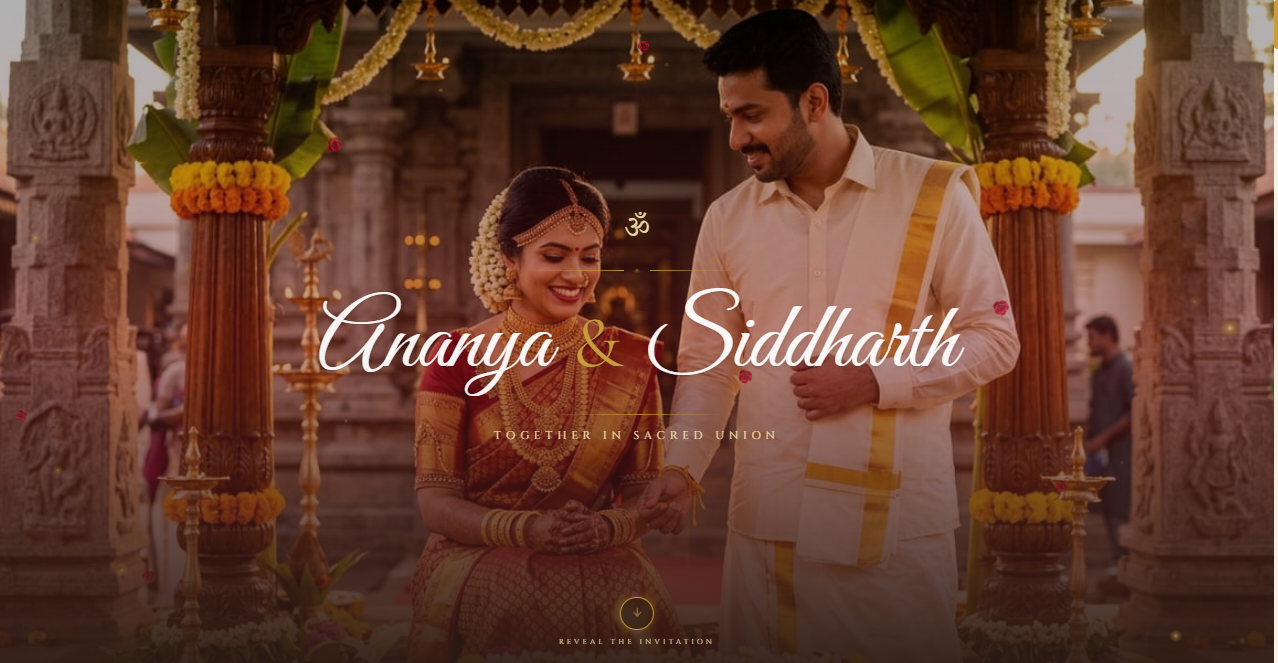
If you've ever tried to fit your name onto a wedding invitation in both English and Malayalam, you already know the problem isn't the translation. It's everything around it — the spacing, which name goes first, whether to use the script at all if half your guest list can't read it, and what to do when your name doesn't have a clean one-to-one equivalent in Malayalam script to begin with.
This comes up constantly for Kerala weddings, especially when the guest list includes relatives in Kochi who read Malayalam comfortably, cousins in Dubai who grew up reading mostly English, and an uncle who insists the invitation "doesn't feel right" without the script somewhere on it. Nobody's wrong here. It's just a genuinely awkward design and wording problem, and most invitation templates — Indian or otherwise — aren't built with it in mind.
Here's how to actually think through it.
Start by deciding what the Malayalam text is actually for
Before worrying about fonts or placement, it helps to be honest about the job the Malayalam text is doing. There are really two different reasons families include it, and they lead to different decisions:
Some of your guests read Malayalam more comfortably than English — often older relatives, or guests who grew up in Kerala and never needed much English day-to-day. For them, the Malayalam isn't decorative. It's the version they'll actually read first.
Even guests who read English perfectly well often still want to see the names in Malayalam, because it signals something about the wedding — that it's rooted, that it hasn't been flattened into a generic English-only format just because it's easier to typeset.
Most Kerala weddings are doing both at once, which is exactly why the wording ends up feeling complicated. Once you know which one matters more to your family, the rest gets easier.
The most common formats families actually use
There's no single "correct" way to do this, but a few patterns show up again and again, and each solves the problem slightly differently.
This treats both scripts as equally important — usually the choice when the couple wants relatives on both sides (English-first and Malayalam-first readers) to feel equally served. It takes more vertical space, which matters if you're working with a printed card.
More traditional, and common when the wedding leans heavily toward older-generation guests or a more classical presentation. The English becomes almost a caption rather than a co-equal name.
A middle ground a lot of younger couples land on — the schedule, venue, and RSVP instructions stay in English for simplicity, but the names themselves, which carry the most personal weight, appear in both scripts at the top.
None of these is more "correct" than the others. It genuinely depends on who's actually going to be reading the invitation, which is worth deciding before you touch the wording itself.
Getting the actual translation right
This is where most of the real mistakes happen — not in choosing a format, but in getting careless with the Malayalam text itself.
Names don't always transliterate cleanly. Many English-spelled names (especially anglicized versions of Arabic, Sanskrit, or biblical names) have more than one plausible Malayalam spelling. If your family has always spelled the name a specific way in Malayalam — on official documents, in other invitations, anywhere — use that spelling, not a fresh transliteration a translation tool generates. A generated version might be technically readable and still look wrong to someone who's seen the name written correctly their whole life.
Get a native speaker to actually read it back, not just check it. Reading Malayalam script correctly is different from reading it out loud naturally. Ask whoever is checking it to say the names aloud from the printed script, without seeing the English spelling first. If what they say doesn't match the name, something's off in the script — usually a vowel length or a conjunct consonant that changes the sound more than it looks like it would on the page.
Watch for honorifics and family name conventions. Kerala naming conventions vary by community and can include house names (tharavadu), father's names, or community-specific honorifics that don't have an English equivalent at all. Decide early whether you're including these, and if so, in which script — mixing them inconsistently across the invitation is one of the more common small errors that make an otherwise nice invitation feel unpolished.
What this looks like on a wedding invitation website versus a printed card
A printed card has to make a permanent decision about all of this the moment it goes to print — if the format doesn't quite work, or a spelling gets caught after 200 cards have shipped, that's a real problem.
This is one of the places a wedding invitation website genuinely behaves differently. Since the page is live rather than printed, a wrong vowel mark or an awkward line break isn't a reprint — it's a correction, visible to every guest with the link the moment you fix it. Wedsaro's Kerala-focused themes support dual English and Malayalam names specifically for this reason — the two scripts are treated as a real, first-class part of the couple's names rather than a decorative addition squeezed in afterward.
Designed for Both Scripts From Day One
Choose from Nilave (Muslim), Thulasi (Hindu), or Grace (Christian) themes with built-in Malayalam script support, dual names, and instant live preview.
Build Your Website on Wedsaro →A quick checklist before you finalize the wording
Pre-Publishing Wording Checklist
- Confirm the Malayalam spelling with someone who's seen the name written correctly before — not just a transliteration tool.
- Read both scripts aloud, separately, to check they actually sound like the same name.
- Decide upfront whether the Malayalam is there for readability, identity, or both — it changes the layout decision.
- Keep formatting consistent for both names in the couple — don't format one more traditionally than the other unless that's a deliberate choice.
- If you're including house names or community-specific honorifics, decide in advance which script carries them.
The honest bottom line
There's no universal template for this because there's no universal Kerala family — a wedding with guests mostly in Thrissur reads differently than one with half the guest list in Dubai reading everything in English first. The format that actually works is the one that matches how your specific guests will actually read the invitation, not the one that looks most traditional or most modern on its own.
Get the spelling checked by someone who already knows it, decide what job the Malayalam text is doing before you decide how big to make it, and if you're building this online rather than printing it, take advantage of the fact that you can actually fix it later if something doesn't look right the first time.