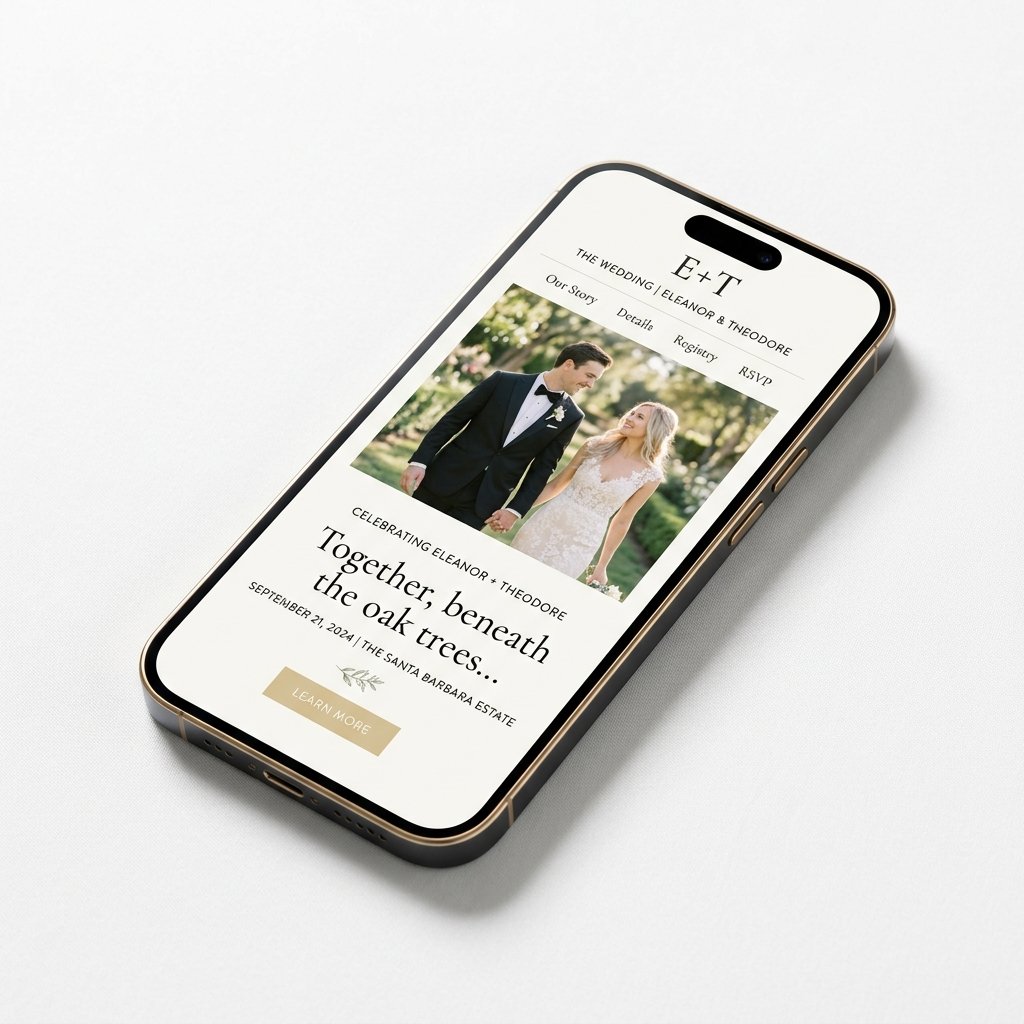
If you've started looking into wedding cards online, you've probably noticed the search results are a mess. Some sites sell you a printable card design. Others make you a short video invite. A few build you something that looks more like an actual website, with a link you can send instead of a file. They all get lumped together under the same searches, and nobody tells you upfront which one you're actually looking at until you're a few clicks deep.
So here's the plain version, without the sales pitch.
The three things people mean when they say "wedding invitation"
This is the most common thing that shows up when you search "wedding cards online." You pick a design, add your names and date, and get back either a printable file or a shareable image — a JPEG or a PDF. It's a card. It just happens to be designed and delivered digitally instead of at a print shop. Once it's made, it's finished. If your venue changes, you're sending a corrected version separately, and hoping everyone who already saved the old one notices.
A step up in production — usually a short animated video with your names, date, and maybe a voiceover or background music, meant to be forwarded on WhatsApp. It feels more personal than a static image, but it's still a single file. Nobody can tap it to check your schedule or RSVP. It's watched once, the same way a card is looked at once, then it disappears into a chat history.
This is a genuinely different thing, even though it often gets search-lumped in with the two above. Instead of a file you send, it's a link to a live page. Guests open it in a browser — no download, no app — and it can hold your full story, your ceremony schedule, your photos, and an actual RSVP form guests fill out directly on the page. And because it's a page, not a file, you can fix something after you've sent it. A typo in the venue name doesn't mean resending anything — you fix it once, and everyone with the link sees the correct version.
Why this distinction actually matters, not just semantically
The real difference isn't really "which one looks nicer." It's what happens after you hit send.
A card or a video invite is a broadcast. It goes out once, and from that point on, it's static — frozen at whatever you decided in the design phase. If your wedding has more than one event (a Mehendi, then a Nikah or Muhurtham, then a reception, say), you're either cramming all of that onto one crowded card, or sending three separate files and hoping people keep track of which is which.
A website behaves differently because it's live. It can hold a full multi-event schedule as one clear list instead of three separate sends. It can take an actual RSVP, so you're not counting thumbs-up reactions in a group chat and guessing at a headcount for catering. And it stays reachable the whole time between now and the wedding, not just the moment someone opens the file you sent them.
Neither format is "wrong." A single-evening wedding at one venue, with a smaller guest list who all live nearby, might genuinely be fine with just a well-designed card. The website format earns its keep specifically when your wedding has more moving parts than a card was ever meant to hold — multiple events, a guest list spread across cities or countries, or a genuine need to track who's actually coming.
What to actually check before you pick one
If you're comparing options right now, a few questions will tell you faster than any homepage copy will:
Decision Checklist for Couples
-
Are you getting a file, or a link?
If what you receive at the end is a JPEG, PDF, or MP4, it's a card or a video invite — however nice the design is. If you get a URL you can share, it's a website. -
Can you edit it after you've sent it?
A card can't be corrected once it's out. A real wedding invitation website usually gives you an editing window after you publish, for exactly this reason — genuine last-minute fixes without needing to resend anything. -
Does it actually collect RSVPs, or just look like it should?
Some card designs include an RSVP-style graphic that isn't functional — it's just part of the design. A real RSVP means guests can tap Yes, No, or Maybe directly on the page, and you can see the responses somewhere, not just imagine they exist. -
Is it built for how many events you actually have?
A single-ceremony template forced to hold a Mehendi, a Nikah, and a reception usually ends up cramped or repetitive. If your wedding spans more than one event, check whether the format was actually built to lay out a full schedule, not just a single date and venue line.
The honest bottom line
"Wedding cards online" and "wedding invitation website" get searched almost interchangeably, but they're not the same product, and picking based on search habit rather than what you actually need is how people end up disappointed halfway through.
If what you want is a beautiful single image to send once, a card does that job well, and there's no reason to overcomplicate it. If your wedding has more than one event, a guest list spread across more than one city, or you're tired of guessing headcounts from a WhatsApp thread, that's specifically the situation a wedding invitation website is built to handle — and it's worth knowing that's what you're looking for before you start comparing options.
Build Your Wedding Invitation Website
Give your guests one clear link with interactive Google Maps navigation, live RSVP headcounts, and multi-event ceremony schedules.
Start Building on WhatsApp →